Discussion Moderator & AI Chat | Discover Now ›
The purpose of an employee survey goes far beyond collecting data: employee surveys are strategic tools for organisational development. In this article, you'll learn which objectives of an employee survey matter most, how they have changed over the years and which measurable improvements they can bring. A separate article explains why employee surveys are important for organisations.
Key takeaways
- Employee surveys pursue four core objectives: increasing motivation, raising satisfaction and retention, identifying areas for improvement and fostering an open communication culture.
- The effect is measurable: up to 51% lower staff turnover, 81% fewer absences and 23% higher profitability among motivated employees.
- Four factors determine success: regularity, transparent communication of results, consistent implementation of actions and a bottom-up approach.
- Employees should be involved as active participants who shape change, not as passive respondents.
Table of contents
- The main objectives of employee surveys at a glance
- How employee surveys have evolved: From control to enablement
- The four main goals of modern employee surveys
- How organisations achieve these objectives with employee surveys
- Frequently asked questions about the purpose of employee surveys
- References
The main objectives of employee surveys at a glance
Organisations pursue four core objectives with employee surveys:
- Increasing motivation: Identifying and fostering individual motivation factors
- Satisfaction and retention: Strengthening employee retention and reducing staff turnover
- Identifying areas for improvement: Systematically identifying weak points
- Strengthening the communication culture: Building trust and transparency
The purpose of employee surveys has changed over the decades: from pure control towards enabling managers and employees and supporting organisational development.
How employee surveys have evolved: From control to enablement
As early as the 1930s, organisations surveyed their employees so that they could act early and head off intervention by trade unions.1 Today, organisations conduct employee surveys less to keep trade unions in check and more to increase their employees' motivation and retain them in the long term. Why?
Because motivated employees move an organisation forward! Motivated employees commit themselves to the organisation:
- in their own work
- in collaboration within the team and across the organisation
- in how they act towards the outside world
In figures, this means that motivated employees have 81% fewer absences, are 18% more productive in sales and are 23% more profitable on average.2
The problem: Despite the long history of employee surveys aimed at improving satisfaction and engagement, many organisations still believe they can simply hire engaged employees.
Our experience shows, however, that real, lasting engagement cannot simply be "hired". It is created and nurtured within the organisation. If employees are not sufficiently involved in developments and cannot identify with the organisation or the changes, engagement fades quickly. Satisfaction drops, and collaboration suffers.
The four main goals of modern employee surveys
This is exactly where the objectives of an employee survey come in: these surveys are a valuable way to gather opinions, improve working conditions and foster a positive organisational culture.
Improving employee motivation
Employee motivation has a major influence on an organisation's productivity and success. Employee surveys help identify the individual needs and motivation factors of employees.
Specific objectives for improving motivation:
- Identifying motivators: Recognising which aspects of their daily work employees particularly value
- Eliminating demotivators: Identifying areas that employees experience as demotivating
- Targeted measures: Introducing recognition programmes, flexible working models or career development plans
- Individual needs: Taking into account the different motivation factors of different employee groups
Increasing employee satisfaction and retention
Employee satisfaction and retention are closely linked. Higher satisfaction often leads to stronger retention and therefore to up to 51% lower staff turnover.3
Objectives for increasing satisfaction:
- Identifying satisfaction factors: Assessing working conditions, pay, leadership and development opportunities
- Improving work-life balance: Measures that make it easier to combine work and private life
- Creating development opportunities: Establishing training programmes and career paths
- Long-term retention: Building a strong emotional bond between employees and the organisation
Identifying areas for improvement
To achieve lasting improvements, you first need to recognise the existing weak points. Employee surveys provide a valuable data basis for this.
Identifying improvements systematically:
- Uncovering weak points: Identifying inefficient processes, insufficient resources or poor communication
- Enabling prioritisation: Ranking areas for improvement by urgency and impact
- Data-based decisions: Deriving concrete actions from the data collected
- Continuous optimisation: Regularly reviewing and adjusting improvement measures
Practical tip: Do you want to increase your employees' engagement and actively involve them in organisational development? Then rely on a bottom-up approach: make sure all employees actively contribute to the change process. That way, changes are accepted for the long term.
Fostering an open communication culture
An open communication culture is the basis for trust and collaboration within an organisation. That is why we at Pulse Feedback believe that employee surveys should only be completely anonymous in exceptional cases.
Objectives for improving communication:
- Building trust: Showing employees that their opinion counts and is valued
- Encouraging dialogue: Laying the foundation for open feedback conversations
- Creating transparency: Communicating results openly and developing measures bottom-up
- Psychological safety: Creating an environment in which employees dare to express their honest opinion
How organisations achieve these objectives with employee surveys
The goal of employee surveys is not only to increase productivity and quality. Even more important is involving employees continuously in this improvement process. This fosters a culture of co-creation, and the interest in the workforce that the surveys demonstrate increases engagement.1
Success factors for achieving the objectives:
- Regularity: Continuous surveys instead of one-off exercises
- Transparency: Open communication of results at all levels
- Focus on implementation: Moving from insights to concrete actions
- Bottom-up approach: Employees as active participants who shape change rather than passive respondents
Our comparison of employee survey providers shows which type of provider best supports these success factors.
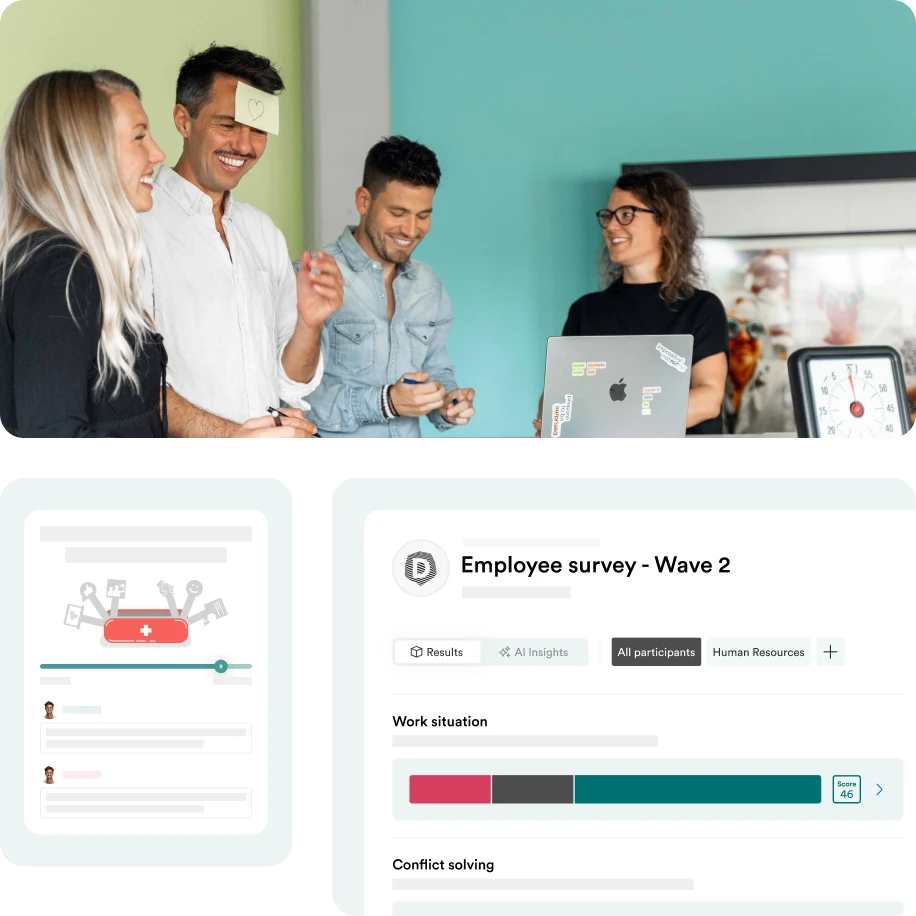
Turning survey objectives into measurable results
Employee surveys that actually change things. A bottom-up approach with openly shared results. Teams work with the results themselves and put improvements into practice directly. HR and management can focus on strategic priorities.
Explore Pulse FeedbackFrequently asked questions about the purpose of employee surveys
What is the main purpose of an employee survey?
The main purpose of an employee survey is usually to identify areas for improvement, because this leads directly to measurable improvements and supports all the other objectives.
How do I set objectives for an employee survey?
Set your objectives using the SMART criteria: specific, measurable, achievable, relevant and time-bound. For example: "Reduce staff turnover by 20% within 12 months."
What do organisations want to achieve with regular employee surveys?
Regular employee surveys mainly aim at continuous improvement and building a strong feedback culture, rather than solving a one-off problem.
Do employee survey goals differ depending on company size?
Yes. Small companies often focus on motivation and satisfaction, while large companies also take strategic decision support and compliance aspects into account.
References
1 ESGVOLUTION. (2023, August 19). https://www.esgvolution.com/de/
2 Harter, J. K., Schmidt, F. L., Agrawal, S., Blue, A., Plowman, S. K., Josh, P., & Asplund, J. (2020). The relationship between engagement at work and organizational outcomes: 2020 Q12 meta-analysis (10th ed.). Gallup. https://www.gallup.com/workplace/321725/gallup-q12-meta-analysis-report.aspx
3 Gallup Inc. (2024). State of the Global Workplace. https://www.gallup.com/workplace/349484/state-of-the-global-workplace.aspx