Discussion Moderator & AI Chat | Discover Now ›
"One size fits all" rarely holds true, and employee surveys are no exception. There are many types of employee surveys: from anonymous surveys to online surveys, and from simple online feedback forms to specialised employee survey software. Which approach suits you depends on your organisation's situation, goals and structure.
This article explains the different employee survey methods and tools, their advantages and disadvantages, and how to choose the right method for your organisation.
Key takeaways
- Employee surveys can be classified by five criteria: anonymity, data type, frequency, format and approach.
- Open surveys encourage more constructive feedback and real dialogue, while anonymity sends the message that giving feedback is dangerous.
- Combining quantitative scales with qualitative comments provides the deepest insights.
- For regular surveys, an interval of three to six months is recommended, mixing short pulse surveys with more comprehensive surveys, plus event-driven surveys for mergers or restructuring. A bottom-up approach, in which teams take ownership of working with their results, is the most effective.
Table of contents
- The main types of employee surveys at a glance
- Should you survey anonymously or openly?
- Should you run a quantitative or qualitative survey?
- When and how often should you run an employee survey?
- Should you survey online or on paper?
- Should you take a top-down or bottom-up approach?
- Frequently asked questions about types of employee surveys
- References
The main types of employee surveys at a glance
The types of employee surveys can be classified by five criteria:
- By anonymity: anonymous or open
- By data type: quantitative or qualitative
- By timing and frequency: event-driven, regular or continuous
- By format: online or on paper
- By approach: top-down or bottom-up
The choice between an anonymous and an open approach, and between different online tools, has a major influence on the success of your survey.
By anonymity
Should you survey anonymously or openly?
For regular surveys, we recommend an open or semi-transparent approach because it enables dialogue and concrete improvements. Anonymous surveys make sense for very sensitive topics such as health or stress.
Choosing between an anonymous employee survey and an open approach is one of the most fundamental decisions when planning employee feedback. Anonymity is often treated as the sacred cow of employee surveys. But does it really deliver what it promises? Or does it perhaps create more problems than it solves?
Further reading: For a detailed analysis of the pros and cons of anonymous surveys, see our article "Employee surveys: Anonymous or not?"
Anonymous employee surveys
An anonymous employee survey promises safety and openness. The traditional assumption is that employees feel safer when they can give critical feedback anonymously. This reduces the fear of direct consequences, and it is a widely accepted approach.
The main advantages:
- Employees feel safer giving critical feedback
- Protects employees from unpleasant consequences
- Traditional, widely accepted approach
In practice, however, anonymity also shows clear weaknesses. Paradoxically, it can reinforce the impression that giving open feedback is inherently dangerous. It implicitly communicates that the people giving feedback need to be protected.1 It can also lead to "witch hunts", in which people try to identify the authors of negative comments. And anonymity often encourages people to "let off steam" with exaggerated accounts, which rarely provide a basis for effective improvements.
Key disadvantages:
- Implicitly suggests that giving open feedback is dangerous
- Can lead to attempts to identify the authors
- Encourages unproductive venting instead of constructive feedback
- Prevents real dialogue between teams and management
Open employee surveys
Open surveys rely on transparency and direct dialogue, like an open platform where everyone shares their knowledge and experience so they can learn from one another. When employees know that others can attribute their feedback to them, they choose their words more carefully, and that is the basis for constructive feedback. Transparency makes meaningful conversations possible and gives everyone the same rights: employees and managers can see each other's feedback.
Key strengths:
- Encourages more constructive, considered feedback
- Enables real discussions and improvements
- Gives everyone the same right to information
- Makes targeted action easier
What matters is introducing it step by step and building trust. The approach works best in organisations that are already working on an open communication culture.2
Points to consider:
- Management must back the approach
- Careful communication along the way is advisable
Practical tip: Transparency does not have to mean full disclosure. In Pulse Feedback, you set how visible comments are for each survey, from fully transparent to fully anonymous. With the semi-transparent setting we recommend, ratings stay anonymous as team scores, while comments are visible across the organisation, with names shown only within your own team. This allows organisation-wide learning while protecting privacy.
By data type
Should you run a quantitative or qualitative survey?
Combining both gives you the most meaningful results: rating questions show where you stand, and open questions explain why.
Another important distinction is the type of data you collect. Quantitative and qualitative approaches each have their strengths and suit different purposes in employee surveys.
Quantitative employee surveys
Quantitative employee surveys work with structured questions and rating scales (e.g. ratings from 1 to 10). They deliver measurable, comparable results and allow statistical evaluation for sound analysis.
Advantages:
- Easy to collect and analyse
- Benchmarking and comparisons possible
- Trends can be measured over time
- Clear dashboards and KPIs
Disadvantages:
- Little insight into the reasons behind the ratings
- Superficial findings
- Few actionable insights
Qualitative employee surveys
Qualitative surveys rely on open questions and free-text comments. They collect detailed, narrative feedback and provide context-rich information about what employees actually experience.
Advantages:
- Valuable source for identifying root causes
- Actionable feedback and concrete suggestions for improvement
- Deeper insights into employees' perspectives
Disadvantages:
- Analysis can be time-consuming if done manually
- Harder to quantify
- Open to subjective interpretation
Combined approaches
Most modern surveys combine quantitative and qualitative elements for the best results.
By timing and frequency
When and how often should you run an employee survey?
Run event-driven surveys for mergers, restructuring or other major changes. For regular surveys, we recommend an interval of three to six months, mixing short pulse surveys with more comprehensive surveys.
How often you survey has a major influence on the impact. One-off surveys provide a snapshot, whereas regular cycles enable continuous improvement and let you track developments over time.
One-off surveys
One-off surveys are used for specific events such as mergers, restructuring or other major changes. They are designed to capture the situation at a particular point in time and to address current challenges or change processes directly. Organisations often use them to understand how employees are reacting to significant changes. The focus is clearly on the current situation, but you cannot measure developments over time.
Regular surveys
Regular surveys, such as the classic annual employee survey, are typically run once a year or every six months and form the backbone of many traditional HR strategies. They allow organisations to measure progress systematically and identify long-term trends. Their structured approach makes them particularly valuable for strategic planning and benchmarking, but they may be too slow for quick adjustments.
Pulse surveys (pulse checks)
Pulse surveys are short, frequent surveys that take place quarterly or even more often. They measure the "pulse" of the organisation with a few targeted questions and let you respond quickly to changes. This method has proven particularly effective in agile organisations that need to respond flexibly to changes in the market. However, it is important to act on the results consistently to avoid survey fatigue.
Continuous surveys
Continuous surveys offer ongoing opportunities to give feedback, with no fixed cycles or dates. Employees can give feedback at any time, which is particularly valuable in dynamic working environments. This approach enables real-time feedback, but it requires a strong structure and clear processes to produce usable insights.
Our recommendation: We recommend regular surveys every three to six months, mixing pulse surveys with more comprehensive regular surveys. In our view, surveying once a year is too infrequent to keep learning and improving. Important: if no actions are derived from the results and set in motion, survey fatigue sets in.
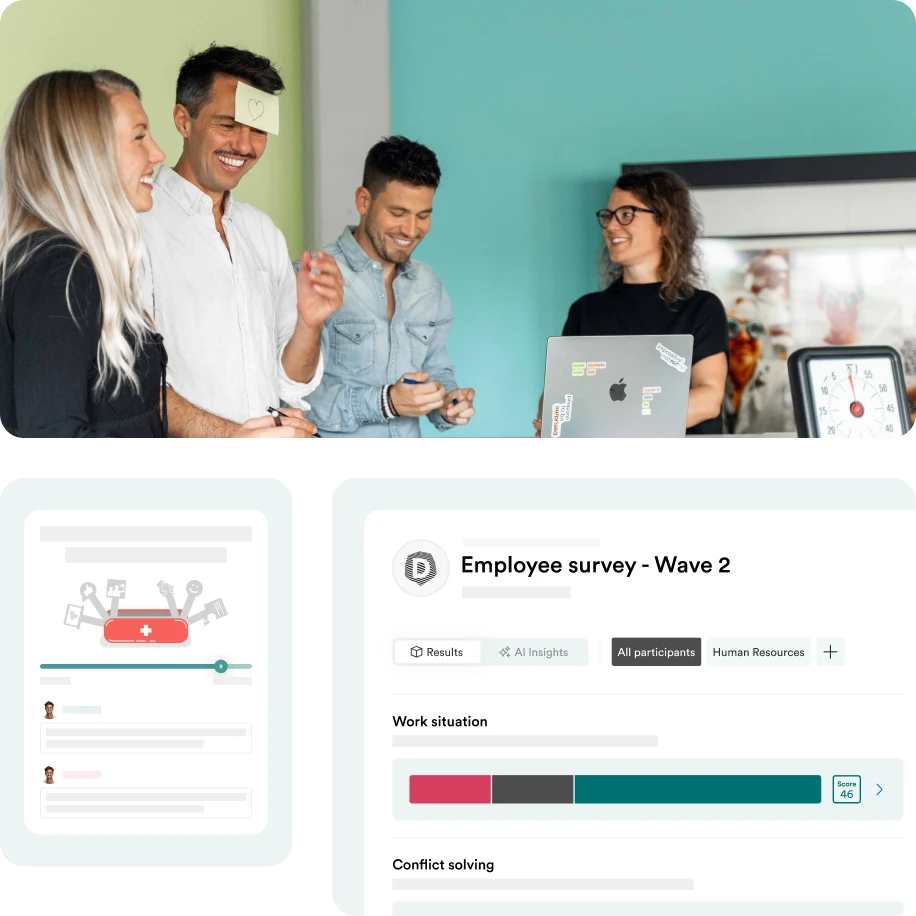
Regular pulse surveys without extra effort
Pulse Feedback covers exactly this rhythm: short surveys with 4 to 7 questions every 3 to 6 months, with real-time results instead of an annual review. This lets you derive actions continuously, before fatigue sets in.
Explore pulse survey softwareBy format
Should you survey online or on paper?
In most organisations, online surveys are now the standard. Paper or a hybrid approach is worthwhile where not all employees can be reached digitally.
Choosing the right format has a major influence on the success of your survey. Online employee surveys have become the standard, but paper-based approaches still have their place in certain situations.
Online employee surveys
An online employee survey offers key advantages for modern organisations. Employees can take part flexibly from anywhere, whether they are working from home, on the road or at different sites. Automatic analysis delivers real-time results and makes the process much more cost-effective for larger groups.
Key advantages:
- Automatic analysis and real-time results
- More cost-effective for larger groups
- Significantly higher response rates than paper surveys
A solid technical foundation and attention to the preferences of different target groups are important here.
A simple online tool such as Google Forms is enough if a smaller organisation mainly wants a one-off measurement. For regular surveys, more complex structures and working with the results, specialised software such as Pulse Feedback is worth it. What to look for when choosing is covered in our guide on how to conduct an employee survey, in the section on free tools such as Google Forms.
Which type of provider suits which situation is explained in our overview of employee survey providers.
Paper-based surveys
Paper-based surveys still have their place in certain contexts. They reach employees who do not work digitally, without any technical barriers, and give you full physical control over data protection.
Advantages:
- Reaches employees who do not work digitally
- No technical barriers
- Full physical control over data protection
However, they come with some practical challenges. Responses have to be analysed or digitised manually, which can quickly take several days or weeks for larger surveys. Costs rise disproportionately with the number of participants because of printing, distribution and manual processing. Results also take much longer to arrive, which makes it harder to respond quickly to urgent issues.
Disadvantages:
- Time-consuming manual analysis
- Higher costs for larger groups
- Much slower results
Hybrid approaches
A combination of digital and paper-based elements to reach every target group.
By approach
Should you take a top-down or bottom-up approach?
We recommend a bottom-up approach: teams work with their own results and make improvements directly, while HR and management focus on overarching issues.
The basic approach of an employee survey determines who controls the process and how the results are handled. Top-down approaches rely on central control by management, while bottom-up approaches put team ownership at the centre.
Further reading: For a detailed comparison of both approaches with practical examples, see our article "Top-down vs. bottom-up employee surveys"
Top-down employee surveys
In top-down employee surveys, results and actions are communicated "from above", and the focus is primarily on measuring the current status quo. A selected group from HR creates the survey, analyses the data and presents the results to management, which decides on actions.
The aim is to answer specific research questions or test hypotheses, for example: "How satisfied are employees with their leadership?" Quantitative data from rating scales that measure predefined metrics dominates.
Advantages:
- Strategic alignment ensured
- Consistent topics across the organisation
- Clear responsibilities
- Ideal for collecting specific data
Disadvantages:
- Employees experience the survey as a dead end
- Little ownership encouraged
- Slower implementation of improvements
Bottom-up employee surveys
Bottom-up approaches let teams work with the results themselves, with a focus on ownership and continuous improvement. Employees take responsibility for how they work together and actively help shape change.
The feedback is meant to trigger specific changes within the teams. Qualitative data from open questions allows detailed suggestions for improvement. The results are shared transparently, so teams can discuss the feedback openly and put improvements in place directly. In the long run, this builds a feedback culture and greater ownership.
Advantages:
- Higher motivation to take part
- Faster local improvements
- Stronger ownership
- Establishes a learning culture
Disadvantages:
- Requires trust in the teams' abilities
- Possibly less strategic coordination
- More facilitation effort
Our approach: Bottom-up employee surveys aim to strengthen employee ownership and build a culture of continuous learning and improvement. Instead of simply measuring the status quo, they enable teams to drive change themselves.
Find the right type of survey for your organisation
Employee surveys that make a real difference. A bottom-up approach: teams work with their own results and put improvements in place directly. HR and management can focus on strategic priorities.
Discover Pulse FeedbackFrequently asked questions about types of employee surveys
What is the best type of employee survey?
There is no single best type: the right choice depends on your goals, your organisational culture and the resources available. Combined approaches (quantitative and qualitative, different frequencies) are often the most effective.
How often should you run an employee survey?
Regular surveys every three to six months enable continuous improvement, and event-driven surveys are useful for mergers, restructuring or other major changes. There is no universally optimal rhythm: whether quarterly pulse surveys or more comprehensive surveys every six months suit you better depends on your organisation's goals and current situation.3 More important than the frequency is that concrete improvements are made between surveys, otherwise survey fatigue sets in.
Pulse survey or annual survey: which is better?
We recommend regular, shorter surveys over a single annual survey, because in our view surveying once a year is too infrequent to keep learning and improving. A mix of short pulse surveys and more comprehensive surveys every three to six months works well. Whichever rhythm you choose, derive actions from the results and put them in place, otherwise survey fatigue sets in.
Should employee surveys be anonymous or open?
It depends on the existing culture of trust. Open surveys encourage more constructive dialogue and allow teams to make improvements directly. Anonymity can make sense for very sensitive, organisation-wide topics, but it should not be the default.
Should I run my employee survey online or on paper?
Online, in most organisations: online surveys are faster, cheaper and analysed automatically, and reminders are easy to send. Paper or a hybrid approach is worthwhile where not all employees can be reached digitally.
References
1 Detert, J. R., & Burris, E. R. (2016). Can your employees really speak freely? Harvard Business Review, January/February 2016. https://hbr.org/2016/01/can-your-employees-really-speak-freely
2 Edmondson, A. C., & Lei, Z. (2014). Psychological safety: The history, renaissance, and future of an interpersonal construct. Annual Review of Organizational Psychology and Organizational Behavior, 1(1), 23–43. https://doi.org/10.1146/annurev-orgpsych-031413-091305
3 Netigate Deutschland GmbH. (2023, May 12). https://www.netigate.net/de/articles/human-resources/wie-oft-sollte-ich-eine-mitarbeiterbefragung-durchfuehren/