Discussion Moderator & AI Chat | Discover Now ›
A successful employee survey is much more than sending out a questionnaire. Every step, from strategic planning to putting the results into practice for the long term, decides whether your project succeeds. Here is how to conduct an employee survey, step by step.
Modern approaches increasingly rely on participatory methods and involve employees actively throughout the process, whether you run your employee survey online or take a more traditional route.
Key takeaways
- A successful employee survey follows six steps: set SMART goals, define the setup, develop questions, plan how to run it, involve stakeholders and launch it professionally.
- Combine quantitative and qualitative questions. Pulse surveys with 4 to 7 questions every 3 to 6 months have more impact than infrequent large-scale surveys.
- The most common mistake: results that lead to no follow-up action.
- In Germany and Switzerland, an employee survey is generally permitted if participation is voluntary, the purpose is clear and data protection is in place. In Germany, if the survey runs on software, an existing works council usually has to agree beforehand.
- Bottom-up approaches, in which teams take ownership of working with their results, bring more lasting change.
Table of contents
- How to conduct an employee survey in 6 steps
- Step 1: Set goals
- Step 2: Define the setup
- Step 3: Develop topics and questions
- Step 4: Plan how to run the employee survey
- Step 5: Prepare and involve stakeholders
- Step 6: Launch the employee survey
- What happens after an employee survey?
-
- Analysing employee survey results properly
- Communicating results transparently
- Dealing with poor results: What should you do?
- From feedback to action: Different approaches to implementation
- Prioritising measures and building an action plan
- Supporting structured implementation
- Learning and improving continuously
- Conclusion: From data collection to a living feedback culture
- Frequently asked questions about conducting employee surveys
- References
How to conduct an employee survey in 6 steps
The employee survey process follows a proven sequence that works whatever method you choose. This systematic approach helps you run your survey in a structured and successful way.
If you are planning to conduct an employee survey, follow these six steps:
1. Set goals: Define concrete, measurable goals for your survey
2. Define the setup: Decide on frequency, duration and who takes part
3. Develop topics and questions: Write focused questions that point to action
4. Plan how to run the employee survey: Choose between running it in-house or with external support
5. Prepare and involve stakeholders: Inform everyone involved and build acceptance
6. Launch the employee survey: Run the survey with professional support
Step 1: Set goals
Before you start, you need to define clear goals. Without concrete objectives, your survey turns into aimless data collection that is of no real use to anyone.
Tip: Modern approaches involve relevant stakeholders as early as the goal-setting stage, from HR and managers to team representatives. This clarifies expectations early on and increases acceptance later.
Formulating concrete goals
Make your goals specific and measurable. Instead of vague statements such as "We want to improve employee satisfaction", be precise: "We want to increase satisfaction with internal communication by 20% and identify concrete improvements."
Decide in advance how you will measure whether you have reached your goals. This allows you to assess the results objectively after the survey and to evaluate how well your measures worked.
Common goals of employee surveys
Raising engagement and motivation
Understand what drives your employees and take targeted action to increase employee motivation and engagement.
Improving leadership quality
Gather constructive 360-degree feedback on leadership behaviour and support managers in their development.
Strengthening collaboration
Spot points of friction in how people work together and use targeted team surveys to develop solutions for more effective collaboration.
Developing workplace culture
Understand how company values are lived and where you can build a stronger feedback culture.
Supporting organisational change
Use regular feedback to guide company transformation successfully and spot resistance early.
Two separate articles explain why organisations run employee surveys and which goals they pursue with them.
Step 2: Define the setup
The setup defines the organisational framework and has a major influence on the quality of your results.
How often should you run surveys?
How often you survey depends on your goals and the resources available. Annual full-scale surveys suit comprehensive satisfaction measurement and strategic topics. Quarterly pulse surveys allow continuous improvement and quick responses to change. Project-related surveys accompany specific transformations.
A continuous feedback culture: Instead of infrequent large-scale surveys, successful organisations increasingly rely on regular, shorter pulse surveys. Teams get used to open dialogue and can respond to change more quickly.
Which occasions call for a survey and which rhythm works well is covered in our overview of the types of employee surveys.
Choosing the right length
The ideal survey length depends on its scope:
- Short pulse surveys: 5–10 minutes (4–7 questions)
- Comprehensive annual surveys: 15–20 minutes (10–15 questions)
- Special surveys: Adapted to the topic
Important: longer surveys often lead to drop-outs and superficial answers.
Defining who takes part
Decide who should take part. Full surveys cover the entire organisation and deliver representative results. In very large organisations, samples can be enough, but they should cover all relevant groups. Surveys aimed at specific target groups focus on particular areas.
Modern approaches also let teams start surveys on their own, for example for specific projects or for regular check-ins on where they stand. This encourages a continuous feedback culture.
Step 3: Develop topics and questions
Choosing the right topics and wording your questions precisely determine the quality of your insights. The rule: every question should link directly to your goals.
From goals to topics
Derive concrete topic areas from your goals. Engagement, for example, covers job content, meaningfulness and motivation. Leadership topics include leadership behaviour, feedback and development. For collaboration, the focus is on team dynamics and communication.
Writing good questions
For each topic area, develop questions that allow both quantitative ratings and qualitative insights. Rating questions with scales measure current satisfaction, while open questions provide concrete suggestions for improvement.
A proven example: "There is open communication in my team" (scale 1–10), complemented by "What I like" and "What I wish for".
A participatory approach: Some organisations involve teams in developing the questions. This ensures that relevant topics are covered and that the questions reflect day-to-day work.
Practical help: You will find concrete examples of effective questions on various topics in our free guide to effective questions.
Anonymous or transparent?
This decision has a considerable effect on the quality of your answers. For regular surveys, we recommend an open or semi-transparent approach. For very sensitive topics such as health or stress, we recommend an anonymous survey.
Anonymous surveys create a sense of safety for sensitive topics and can encourage more honest answers. They are particularly suitable for critical topics or where trust is lacking.
Transparent surveys allow more constructive discussions, targeted follow-up questions and direct dialogue between teams and managers. Transparent approaches can lead to more lasting improvements because they make real conversations about the results possible.
Hybrid approaches combine both methods depending on the topic: sensitive topics anonymously, constructive development topics transparently.
We compare both approaches in detail in the article Employee surveys: Anonymous or not?.
Less is more
Concentrate on the questions that really matter. For pulse surveys, 4–7 questions are ideal, while comprehensive annual surveys can include 10–15 questions. A clear thematic focus matters more than broad coverage.
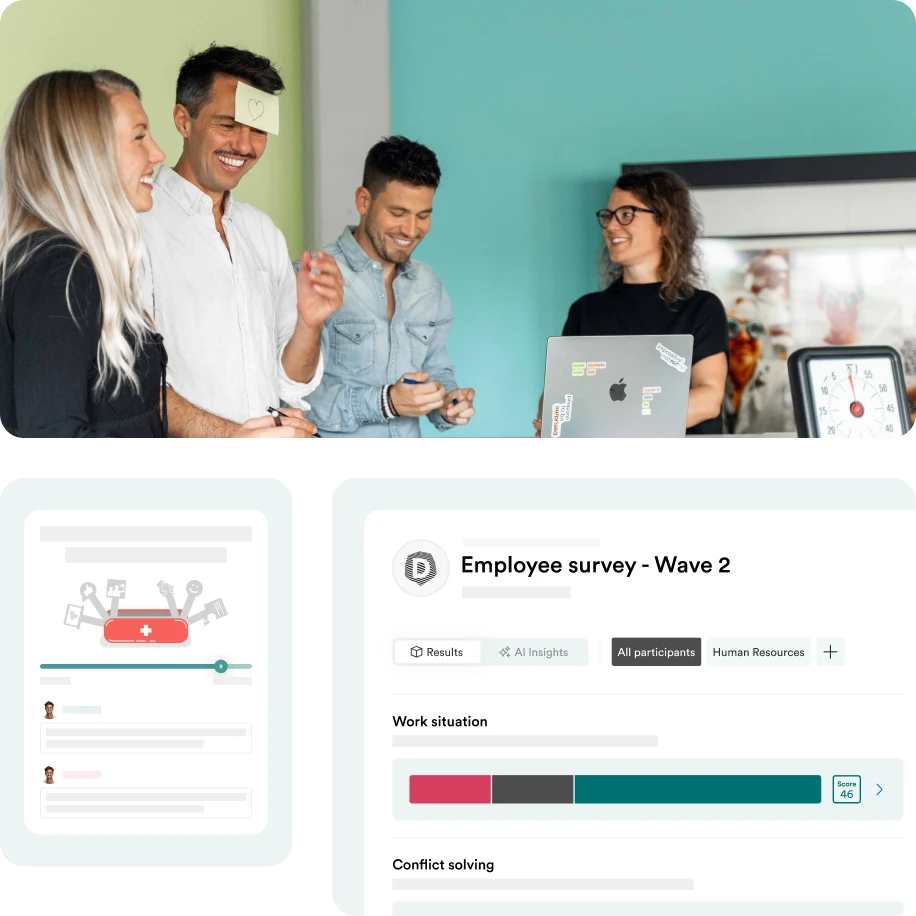
Scientifically grounded questions, ready to use
Instead of starting with a blank page, you use proven question catalogues in Pulse Feedback, each focused on one topic. A few effective questions, ready to go in minutes.
Explore Pulse FeedbackStep 4: Plan how to run the employee survey
Now you need to decide how to carry out the survey. The choice depends on the resources available, your in-house expertise and the level of objectivity you want.
In-house or external?
Running it in-house gives you full control and makes use of your knowledge of the organisation. You save costs and can communicate directly. However, you need in-house expertise and should expect it to take more time.
External support brings professional experience and an objective perspective, takes pressure off your resources and makes benchmarking possible. The challenges are higher costs and longer lines of communication.
Regional vs. international providers: Local providers often understand specific working cultures better and can respond more quickly. International providers offer broad benchmarks but may be less flexible about cultural particularities, for example those of the DACH region (Germany, Austria and Switzerland). Our comparison of employee survey providers gives you an overview of the options.
Online or offline: Which suits you?
Running your employee survey online has many advantages: fast distribution, automatic analysis, lower costs and easy reminders. This method is particularly suitable for tech-savvy teams, remote workplaces and quick pulse surveys.
Offline surveys have the advantage of personal contact. They work where not all employees can be reached digitally, for example in production, logistics or care, and for sensitive topics. Hybrid approaches allow people to take part through different channels.
We compare the pros and cons of online, paper and hybrid surveys in our article on employee survey methods.
Is a free tool like Google Forms enough?
A free tool such as Google Forms or Microsoft Forms is enough if you work in a smaller organisation and mainly want to take a one-off measurement. As soon as you survey regularly, need to map a more complex organisational structure or want teams to work with their own results, you are better served by employee survey software. The difference shows mainly in four areas:
- Higher response rate: Software automatically reminds everyone who has not yet taken part, and it works on any device and in several languages. With a form tool, you send reminders by hand to everyone, including those who have already responded.
- More trust, more open answers: It is clearly defined who sees which results, and small teams stay protected because their ratings only appear once a minimum number of responses is reached. In a form tool, you have to ensure this yourself.
- Results without manual work: Results are available in real time, broken down by team and department and compared with the last survey. With a form tool, you rebuild the organisational structure in a spreadsheet and prepare the data from scratch for every survey.
- Impact instead of a report: Teams see their own results and discuss them together, supported by AI summaries and discussion guides. People who see that something changes take part again next time.
That is why the cost advantage of a free tool is often used up quickly: the effort for reminders, data preparation and analysis comes back with every survey.
Step 5: Prepare and involve stakeholders
Success depends on involving all relevant players early. What matters most here? Preparing everyone involved systematically.
Identifying key players
Think of all internal stakeholders: the HR team for strategic direction, senior management for leadership buy-in, employee representatives for legal compliance, the IT department for technical implementation and internal communications for consistent messaging.
Teams as stakeholders: Don't forget to involve team leads and team representatives early too. They know the operational challenges best and can provide valuable input on practical implementation.
Inform everyone as early as the concept phase. This creates transparency, prevents surprises and brings in valuable input for improving the concept.
Thinking about change management
Prepare your organisation systematically. Communicate the benefits for everyone involved, explain the process openly and set realistic expectations. Address possible concerns proactively.
Clarifying the legal side: What is allowed in Germany and Switzerland?
In Germany and Switzerland, an employee survey is generally permitted. Three points matter: voluntary participation, a clearly defined purpose and data protection. If the survey runs on software, an existing works council in Germany usually has to agree beforehand.
- Voluntary participation: People who don't take part must not suffer any disadvantage.
- Purpose limitation: Announce in advance what the results will be used for, and stick to it. A survey on collaboration, for example, is not suitable for assessing the performance of individuals.
- Data protection: In the EU, the GDPR applies. In Switzerland, the revised Swiss Federal Act on Data Protection (revised FADP) applies and, for employment relationships, Art. 328b of the Swiss Code of Obligations. If you work with an external provider, you need a data processing agreement and should check whether the hosting meets your requirements (e.g. hosting in the EU).
- Sensitive questions: Health data is a special category of personal data under Art. 9 GDPR and sensitive personal data under Art. 5 of the revised FADP. Only ask for it if it is necessary for your goal, and preferably run surveys on such topics anonymously.
- Works council in Germany: For surveys run on software, the works council usually has a right of co-determination (Section 87(1) no. 6 of the German Works Constitution Act, BetrVG), because such systems can record behaviour or performance. A works agreement often sets out the details.
- Employee representation in Switzerland: There is no right of co-determination like the one in Germany. However, employee representatives have information rights and, on questions of health protection, consultation rights (Swiss Participation Act). Involving them early builds trust.
Our three tips for working with employee representatives show you how to turn them into allies.
This overview is not a substitute for legal advice. Clarify the details for your organisation with your legal or data protection advisers.
Step 6: Launch the employee survey
The launch has a major influence on the response rate and the quality of the feedback. Professional communication is key.
Communication that gets through
Start with advance notice one week before launch. Announce the survey with clear goals, explain the process and be transparent about how the data will be used. Emphasise that participation is voluntary.
The invitation should be personal and motivating. State the duration and deadline clearly, make access easy and offer a contact for questions.
Participatory communication: Have managers explain the goals in their teams and answer questions directly. This brings the survey closer to the teams and shows that management stands behind it.
During the survey: send regular updates without putting pressure on people, send polite reminders and communicate openly if problems arise.
Providing support
Offer both technical and content-related support. This includes an e-mail address or phone number for technical problems and employee queries. On the content side, contact people should be available for questions so that anything unclear is resolved quickly.
Increasing the response rate
Managers should lead by example and take part themselves. Send reminders at different times of day, allow flexible participation on different devices and stress that every single voice counts.
What happens after an employee survey?
The most important part starts after the survey: analysing the results, sharing them promptly with everyone, deriving and prioritising measures, supporting implementation and learning from every round. What happens next decides whether your whole project succeeds or fails. Feedback does not work automatically: on average it improves performance, but in more than a third of cases it actually makes performance worse.1 Only by working constructively with the results does a survey have a real effect.
Analysing employee survey results properly
Combine quantitative and qualitative analysis. Analyse ratings statistically, compare departments and look at trends. At the same time, evaluate open answers systematically, categorise suggestions for improvement and identify recurring patterns.
Analyse by team: Compare each team with the overall score of the organisation and with its last survey. This shows you where a team stands and whether it is making progress. Team scores should only become visible once a minimum number of responses is reached, so that nobody can draw conclusions about individuals. The analysis is most useful when teams see their own results and discuss them together.
Modern analysis tools can speed up this process considerably: AI-based systems automatically detect key themes in comments, categorise feedback and suggest concrete actions. This saves time and helps you spot subtle patterns that might be missed in a manual analysis. Why the decisive work still happens in the team is explained in our article on AI and employee feedback.
Communicating results transparently
Share the key findings promptly with everyone involved. Delays lead to speculation and a loss of trust. Prepare different views: overall results for the organisation, department-specific results for teams and clear summaries for different audiences.
Real-time results are becoming more important: modern platforms show results immediately after people take part, which allows quick responses and increases participants' engagement. Teams can discuss their situation straight away, while the survey is still fresh in their minds.
Dealing with poor results: What should you do?
Poor results are above all valuable information: they show where things are stuck in day-to-day work. Share them promptly and without sugar-coating, thank people for their openness and don't justify yourself. Let teams talk about the causes before any measures are decided. Then start with two or three quick wins so that everyone can see something is happening. Topics such as pay, workload or collaboration between departments are things a team cannot solve on its own. HR and senior management take responsibility for these and make visible what they are doing about them.
From feedback to action: Different approaches to implementation
How you implement the results largely determines the success of your survey. There are several proven approaches:
Central implementation:
The classic approach, in which HR or external consultants analyse the results and develop organisation-wide measures. Particularly suitable for:
- Strategic, organisation-wide topics
- Complex analyses and benchmarking
- Standardised processes and measures
Decentralised implementation:
Teams and departments work directly with their results and develop local solutions. This approach suits:
- Strengthening collaboration
- Quick, pragmatic improvements
- Strengthening local ownership
Hybrid approaches:
A combination of both methods: central coordination for strategic topics, decentralised implementation for operational improvements.
Prioritising measures and building an action plan
Whichever approach you choose, prioritise measures systematically:
Quick wins: Improvements that are easy to implement and have an immediate effect
Strategic measures: Long-term projects with high impact
Pilot projects: New approaches that are first tested on a small scale
For each priority level, draw up a concrete action plan with clear responsibilities, measurable goals and regular progress checks.
Supporting structured implementation
Whatever their implementation approach, successful organisations provide practical resources:
- Guides for a structured discussion of the results
- Templates for action planning and progress tracking
- Training for managers on discussing results
- Regular reviews to measure success and make adjustments
Learning and improving continuously
After each survey, reflect systematically: What worked well? What challenges came up? How can the process be improved?
Learning at different levels:
- Individual: What insights have individual managers gained?
- Team: Which local measures were successful?
- Organisation: Which best practices can be shared?
- Process: How can the survey method be developed further?
Conclusion: From data collection to a living feedback culture
A successful employee survey is a systematic process in which collecting data is only one step. What matters most is consistently acting on the findings and actively involving everyone concerned.
Participatory approaches are gaining ground: teams get direct access to their results, develop improvements on their own and take responsibility for implementing them. This bottom-up approach can lead to more lasting change and higher employee satisfaction.
For a systematic approach to implementation, we have developed a free practical guide to effective employee surveys that gives you concrete templates and checklists.
Run an employee survey in days, not weeks
Employee surveys that really make a difference. Intuitive survey creation, automated processes, a scientific foundation. GDPR-compliant, hosted on AWS servers in the EU (Frankfurt and Dublin).
Explore employee survey softwareFrequently asked questions about conducting employee surveys
How do I conduct an employee survey?
You conduct an employee survey in six steps: set goals, define the setup, develop topics and questions, plan how to run the survey, prepare and involve stakeholders, and launch it. What matters most along the way are clear goals, GDPR-compliant data processing, transparent communication, a reasonable survey length and, above all, consistent action on the results.
What legal requirements apply to employee surveys in Germany and Switzerland?
In Germany and Switzerland, employee surveys are generally permitted. Participation should be voluntary, the results may only be used for the announced purpose, and data protection under the GDPR or, in Switzerland, the revised Swiss Federal Act on Data Protection (revised FADP) must be respected. In Germany, if the survey runs on software, a works council usually has a right of co-determination.
Is employee survey software worth it, or is Google Forms enough?
In most cases, employee survey software is worth it. A free tool such as Google Forms is enough if a smaller organisation mainly wants to take a one-off measurement. As soon as you survey regularly, your organisational structure is more complex or teams are meant to work with their own results, employee survey software pays off: automatic reminders lead to a higher response rate, results are available broken down by team without manual work, and teams can derive measures from them directly.
How long should an employee survey take?
Short pulse surveys should take no longer than 5–10 minutes, more comprehensive surveys 15–20 minutes at most. Longer surveys lead to drop-outs and superficial answers.
What happens after an employee survey?
After an employee survey, the results are analysed and shared promptly with everyone involved. Management and teams then derive measures, prioritise them and put them into practice. Most progress is made when teams work with their own results and employees see what changes as a result of their feedback.
How do you turn employee survey results into action?
To turn employee survey results into action, prioritise the measures and draw up a concrete action plan for each priority level, with clear responsibilities, measurable goals and regular progress checks. Start with quick wins so that everyone sees something is happening, then move on to strategic measures and small-scale pilot projects. Teams work directly on what they can solve locally, while strategic, organisation-wide topics are coordinated centrally.
What should you do if your employee survey results are bad?
Handle bad results openly: share them promptly, thank people for their openness and don't justify yourself. Teams then discuss the causes and implement the first quick wins. Topics such as pay or workload are things a team cannot solve on its own: here HR and senior management take responsibility and make visible what they are doing.
What is the most common mistake in employee surveys?
The biggest mistake is not acting once the data has been collected. Surveys without visible follow-up lead to cynicism and a declining willingness to take part.
How do you increase the response rate of an employee survey?
You increase the response rate through transparent communication about goals and benefits, easy participation, a reasonable survey length and, above all, visible action on the results of previous surveys.
References
1 Kluger, A. N., & DeNisi, A. (1996). The effects of feedback interventions on performance: A historical review, a meta-analysis, and a preliminary feedback intervention theory. Psychological Bulletin, 119(2), 254–284. https://doi.org/10.1037/0033-2909.119.2.254