Discussion Moderator & AI Chat | Discover Now ›
The benefits of employee surveys are measurable: from spotting problems early to supporting strategic decisions, well-run employee surveys bring organisations clear advantages.
In this article, you'll learn which concrete benefits employee surveys bring and how these benefits play out in practice.
Key takeaways
- Employee surveys detect problems early and make preventive action possible before staff turnover or productivity losses occur.
- They support strategic decisions with a direct link to operational reality.
- Regular feedback uncovers inefficient processes and increases productivity, because solutions developed bottom-up are more widely accepted.
- They foster a culture of psychological safety, trust and personal responsibility.
- The benefits show up in measurable KPIs as well as in long-term organisational development.
Table of contents
- Why are employee surveys important?
- The four key benefits of employee surveys
Why are employee surveys important?
Employee surveys are important because they help organisations spot problems before these lead to staff turnover or lost productivity. The results support strategic decisions with knowledge from everyday work, uncover inefficient processes and strengthen trust and personal responsibility.
The four key benefits of employee surveys
The benefits of an employee survey show up in four core areas that contribute directly to an organisation's success:
Early detection of problems
Regular employee surveys make it possible to identify and address potential problems early, before they have serious consequences. Spotting dissatisfaction early lets you start change processes before the dissatisfaction shows up as higher staff turnover or lost productivity.
Specific benefits of early detection
- Cost savings: Preventive measures are much cheaper than reacting to problems that have already taken hold
- Retaining talent: Dissatisfied employees can be kept before they resign
- Preventing burnout: Signs of overload are recognised in time
- Proactive leadership: Managers can act in a targeted way instead of only reacting
Organisations that run surveys regularly are better able to identify problems early and act accordingly.1
Support for strategic decision-making
Employee surveys provide valuable data that support strategy implementation and decision-making with data. Their close link to operational work is particularly important for strategic decisions.
How employee feedback improves strategic decisions
- Reality check: Strategies are measured against operational reality
- Acceptance check: New initiatives can be tested before they are introduced
- Resource allocation: Investments are targeted more precisely
- Change management: Transformation processes are steered on the basis of data
Organisations that include employee feedback in their strategic planning make better decisions and become more competitive as a result.2
Higher productivity and efficiency
Employee surveys help identify and improve inefficient processes and ways of working. Because the concrete suggestions for improvement come from operational work, the resulting changes are more readily accepted during a change process and are put into everyday practice faster.
How process improvements pay off
- Better workflows: Employees identify bottlenecks and inefficiencies directly where they work
- Faster implementation: Suggestions for improvement from practice are more likely to be accepted and implemented
- Lasting change: Solutions developed bottom-up have a higher chance of success
- Continuous improvement: Regular feedback makes step-by-step improvements possible
Strengthening organisational culture
An often overlooked but decisive benefit of employee surveys lies in the cultural development of the organisation. Regular feedback creates a culture of dialogue, transparency and continuous improvement.
Cultural benefits
- Psychological safety: Employees dare to speak their minds3
- Trust: Management shows that it values the opinions of the workforce
- Personal responsibility: Teams take responsibility for improvements
- Innovation: Open communication encourages creative solutions
Practical tip: Our bottom-up approach at Pulse Feedback lets all employees, not just HR and management, work directly with the results and put improvements into practice on their own. Instead of only the leadership level defining measures, teams can take responsibility themselves and improve their collaboration in a targeted way.
The measurable benefits of employee surveys
Investing in employee surveys pays off in measurable ways. The benefits of an employee survey show up not only in soft factors but also in concrete improvements across different areas of the organisation.
What the benefits look like in practice
- Early detection prevents costs: Solving problems proactively through employee surveys is cheaper than damage control
- Better decisions: Data-based strategies are more likely to succeed
- Greater acceptance: Solutions developed by employees are implemented more effectively
- Stronger organisational culture: The benefits of employee surveys show up especially in more open dialogue and higher engagement
For these benefits to materialise, you need clear objectives and the right partner: our overview of employee survey providers shows which type of provider suits which objective.
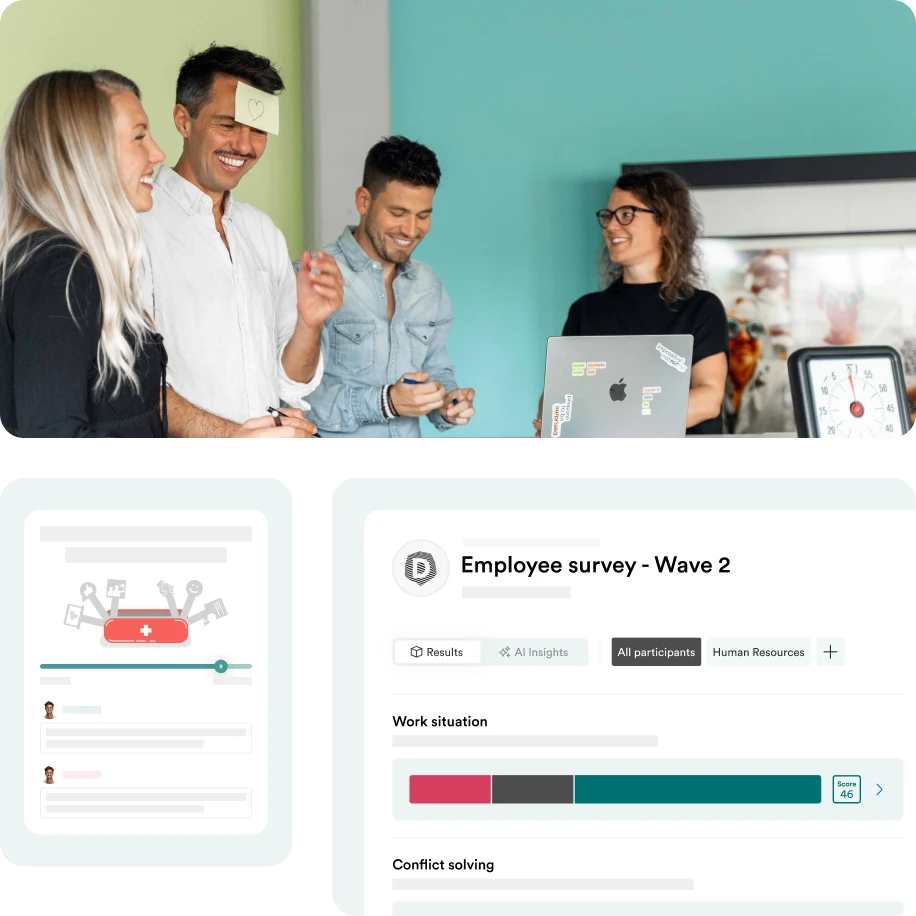
Turning the benefits of employee surveys into real impact
Employee surveys that actually change things. A bottom-up approach with openly shared results. Teams work with the results themselves and put improvements into practice directly. HR and management can focus on strategic priorities.
Explore employee survey softwareFrequently asked questions about the pros and cons of employee surveys
How does an employee survey help an organisation?
An employee survey shows what is working well in everyday work and where things are getting stuck, before this turns into resignations or lost productivity. It gives managers and teams a shared basis for decisions and improvements. However, it only delivers these benefits when the results lead to visible action.
What are the disadvantages of employee surveys?
The main disadvantages of employee surveys are the effort they take and the frustration they cause when no action follows. Preparing a survey, running it and following up on the results takes time. If employees see no visible changes after a survey, they become frustrated and less willing to take part next time, which leads to survey fatigue. A survey run only once also gives just a snapshot, so problems that develop between surveys can go unnoticed.
Are employee surveys worth it for small companies?
Yes, surveys can be valuable from as few as 20 employees, especially for detecting problems early.
How long does it take to see the benefits of an employee survey?
First improvements are often visible after 2–3 months, and the full benefit develops over 6–12 months.
What is the most important benefit of employee surveys?
Early detection of problems usually offers the greatest return on investment, because prevention is cheaper than damage control.
References
1 IBM Corporation. (2017). https://www.ibm.com/downloads/cas/0O6GXMQE
2 De Smet, A., Hewes, C., & Weiss, L. (2020, September 9). https://www.mckinsey.com/capabilities/people-and-organizational-performance/our-insights/for-smarter-decisions-empower-your-employees
3 Frazier, M. L., Fainshmidt, S., Klinger, R. L., Pezeshkan, A., & Vracheva, V. (2017). Psychological safety: A meta-analytic review and extension. Personnel Psychology, 70(1), 113–165. https://doi.org/10.1111/peps.12183