Discussion Moderator & AI Chat | Discover Now ›
An employee survey is a strategic instrument for organisational and employee development. But what makes an employee survey successful? In this article, we explain what an employee survey is, show you proven methods and give you practical tips for putting it into practice.
Key takeaways
- An employee survey systematically captures organisation-specific topics such as job satisfaction, leadership quality and organisational culture, either for a specific reason or at regular intervals.
- Regularity pays off: quarterly surveys reveal trends in good time.
- Openness instead of anonymity leads to more constructive feedback and better conversations.
- Bottom-up involvement: employees are actively involved in finding solutions.
- Consistent follow-through is what counts. Value is only created through noticeable improvements in day-to-day work.
Table of contents
Definition: What is an employee survey?
An employee survey is a systematic survey of the employees of an organisation. It is carried out either in response to a specific occasion or routinely at defined intervals.1
This means employee surveys either deliver one-off, diagnostic results for specific problems or form part of ongoing organisational and employee development. The purpose of an employee survey can vary widely. Many organisations work with specialised employee survey providers whose software makes the process easy to set up and repeat.
Unlike a general opinion poll, an employee survey (also called an employee opinion survey or staff survey) focuses on topics specific to the organisation, such as job satisfaction, leadership quality, working environment and organisational culture.
How does an employee survey work?
The employee survey process usually follows a clear structure: after planning and defining the questions, employees are invited to take part. Today, data is mostly collected digitally, followed by the analysis and the most important step: implementing actions based on the findings. Our article on how to conduct an employee survey explains what is legally permitted in Germany, Austria and Switzerland, from data protection to the works council.
What are the best practices for employee surveys?
Three principles make employee surveys successful: running them regularly, building openness and trust, and involving employees in putting actions into practice. Established employee survey methods and approaches support you along the way, but the benefits of employee surveys only materialise when these principles are in place.
1. Regularity and continuity
Regular employee surveys are the basis for collecting data you can use over the long term and for tracking how employee satisfaction and retention develop. We recommend quarterly pulse surveys so you can spot trends and respond to changes in good time.
Why does this matter? Individual snapshots can be misleading. Only continuous measurement reveals meaningful patterns that make real improvement possible.
2. Openness and trust
Whether employee surveys succeed depends heavily on openness and trust. Instead of relying on anonymous surveys, organisations should foster a culture in which employees can express their opinions openly and honestly without fear of negative consequences. This requires transparent communication and an organisational culture that sees criticism and feedback as an opportunity to improve.
Open rather than anonymous: When people can put their name to their feedback, it becomes more constructive and leads to better conversations. Anonymity can encourage more honest answers in some cases, but it often produces generic responses that offer little guidance for action. It also prevents a genuine feedback culture from developing. This approach moves beyond the traditional definition of an employee survey as anonymous data collection.
3. Involving employees in implementation
A successful employee survey does not end with data collection. What matters is that the feedback is turned into concrete actions. Employees should be involved in finding solutions to make sure the actions are relevant and workable. This can happen through workshops, feedback sessions and working groups. Involving employees in this process on an ongoing basis strengthens motivation and engagement as well as acceptance of the actions.
Bottom-up instead of top-down: The best solutions often come from where the challenges are experienced every day. When teams can work on their own improvements, both the quality of the actions and the motivation to implement them increase.
Conclusion: What makes an employee survey successful?
Measuring alone is not enough. What counts is acting on the results. An employee survey is only successful when it leads to noticeable improvements in day-to-day work.
Employee surveys lay the foundation for an organisational culture in which employees' opinions and needs are taken seriously. With regular, systematic surveys, you can increase your employees' satisfaction and motivation and initiate targeted actions to improve working conditions and processes.
Introducing employee surveys and using them consistently requires commitment and a willingness to change at every level of the organisation, whether you work with simple forms or dedicated employee survey software. The effort pays off: organisations that involve their employees and take their feedback seriously create a positive and productive working environment that contributes to their long-term success. In Switzerland in particular, employee surveys enjoy a high level of acceptance thanks to the participatory working culture.
From definition to your first employee survey
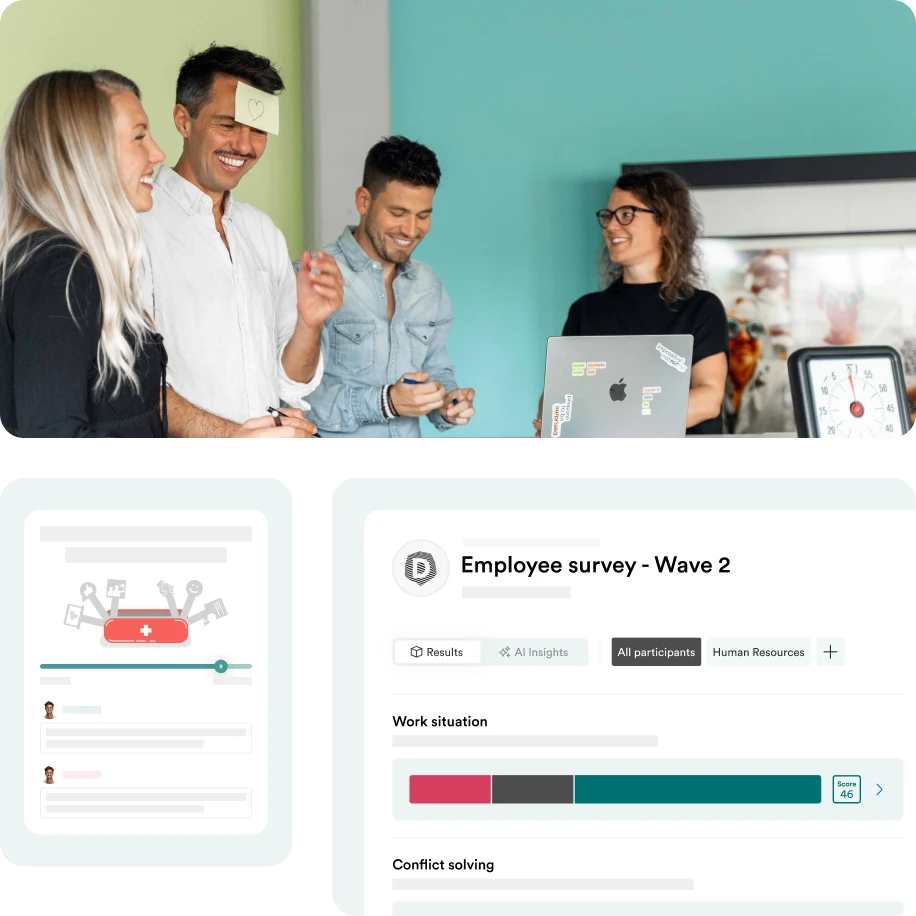
You now know what defines an employee survey. With Pulse Feedback, you can set one up in a few steps: scientifically grounded questions, results that teams see for themselves and actions that teams put into practice on their own.
Explore employee survey softwareReferences
1 Müller, T., Kempen, R., & Straatmann, T. (2021). Employee surveys in organizations: A systematic review. Journal of Business Research, 132, 461–475.