Discussion Moderator & AI Chat | Discover Now ›
Which questions belong in an employee survey? Here you'll find sample employee survey questions and several ready-made questionnaire templates that you can use straight away.
Key takeaways
- Good questions follow from the goals of the survey. First the goal, then the topic, then the question.
- Every question combines a number with a comment. The number shows the what, the comment the why.
- 4 to 7 questions work best for short surveys, 10 to 15 for comprehensive annual surveys.
- This article offers sample questions on seven topics, five ready-made sample questionnaires and tips on writing your own questions.
- The questions come from a question bank we developed with the Lucerne University of Applied Sciences and Arts, based on the JD-R model from work psychology.
Table of contents
What matters most: Start with the goal
Before you choose your employee survey questions, be clear about the goal. Do you want to measure engagement, support a change or improve collaboration within the team? The goal determines the topics, and the topics determine the individual questions. If a question doesn't serve any of your goals, you probably don't need it.
Focus on the questions that really matter. For short pulse and team surveys, 4 to 7 questions are ideal, while comprehensive annual surveys can include 10 to 15 questions. A clear thematic focus matters more than broad coverage.
We describe the whole process, from setting goals to taking action, in our article on how to conduct an employee survey. To find out which goals work particularly well, read about the purpose of an employee survey.
Sample employee survey questions
The following questions were not chosen at random. We developed them together with the Lucerne University of Applied Sciences and Arts. They are based on the job demands-resources (JD-R) model from work psychology1. It shows that engagement develops above all where people have the resources they need: autonomy, good feedback, support and opportunities to develop.2 These are exactly the drivers the following questions cover. You can read how the question bank was developed in our article on the scientific basis of the question bank.
Our recommendation: have people answer each question on a scale from 1 (disagree) to 10 (fully agree), and add two comment fields, What I like and What I wish for. The number shows you where to look, the comments explain why. The What I like field also makes visible what is already going well and gives people the energy to tackle the critical points.
Engagement and motivation
Engagement shows how connected employees feel to their work and how much energy they put into it.
- I currently have everything I need to do a good job.
- I am excited to work at my job.
- When I get up in the morning, I'm keen to go to work.
- I am proud of the work we do.
- I would recommend my company as an employer.
Leadership
Questions on leadership show how employees experience working with their managers.
- My managers (i.e., line managers and specialists) support me in doing a good job.
- My managers (i.e., line managers and specialists) allow the necessary autonomy to enable independent work.
- My managers (i.e., line managers and specialists) show recognition for good performance.
- My managers (i.e., line managers and specialists) give me feedback that helps me improve.
- My managers (i.e., line managers and specialists) promote the continuous development of skills, for all colleagues.
Collaboration
These questions look at how well people work together, both within the team and across teams.
- In my work environment, we regularly discuss what we want to achieve and how each of us might contribute to those goals.
- In my work environment, it is easy to discuss difficult issues and problems.
- The collaboration with colleagues from other teams works well.
- In my work environment we collectively learn from mistakes.
- In my work environment, I am able to rely on others.
Working environment and conditions
These questions cover the conditions that make good work possible or get in its way.
- In my working environment, I have the necessary freedom of action to be able to work well.
- The available tools and processes help me to do a good job.
- At the end of the working day, I usually have the feeling that I have done something meaningful.
- In my work environment, work is distributed fairly.
- I can bring about improvements in my daily work.
Development
Development shows whether employees can learn, grow and reach their potential.
- In my work environment, I receive recognition when I do good work.
- My tasks challenge me in a good way.
- My company enables me to develop myself professionally.
- In my company I can develop as a person.
Company culture and values
Culture questions show whether values are lived day to day and where things still get stuck.
- In my work environment, I feel safe to take calculated risks.
- I can identify with the values of my company.
- We can put the company's values into practice in our day-to-day work.
- Our corporate culture is an important building block for the success of our company.
- In my work environment, we consider the ethical consequences of our own actions.
Change and transformation
In times of change, feedback helps you spot uncertainty early and shape the change together.
- I feel well informed about the impact that current changes will have on my daily work.
- The change will make my work easier in the future.
- The current change is vital to our company's long-term success.
- I am actively involved in shaping the change.
- Our feedback on the current situation has been taken into account.
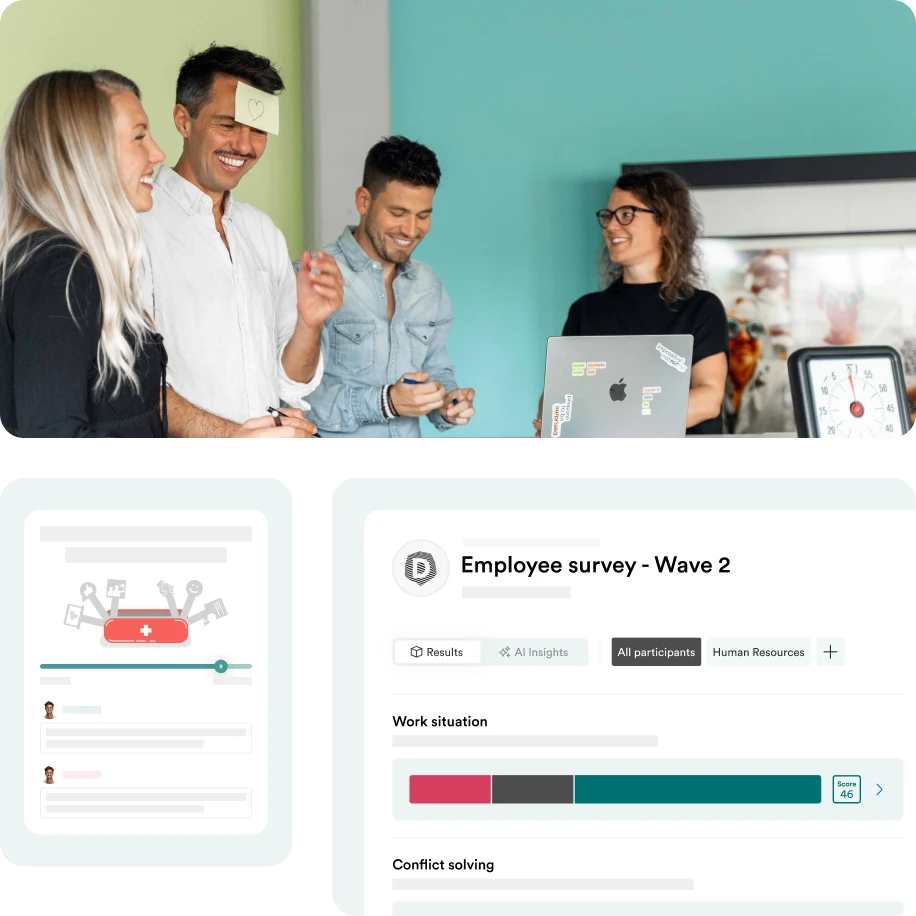
Proven questions instead of a blank page
You don't have to put the questions together yourself. Pulse Feedback provides research-based questions, sorted by topic, that you can use as they are or adapt to your organisation.
Explore employee survey softwareThe most effective opening question
We developed this question specifically as the opening question of a survey:
I currently have everything I need to do a good job.
It is deliberately open. Instead of setting a topic, it brings up whatever matters most right now, often including things nobody would have thought of when the survey was created. During the coronavirus pandemic, for example, employees suddenly wrote about missing equipment for working from home, a topic that wasn't on any questionnaire.
This is how the question uncovers blind spots, and that is exactly why it has proven itself so often as an opener.
Employee survey templates: Ready-made questionnaires to copy
You can combine the sample questions yourself or use one of the following templates as it is. Each of these employee survey questionnaires is tailored to a specific goal and needs only 4 to 5 questions, enough for one topic and short enough to keep participation high.
Template 1: Engagement
Goal: measure how engaged and motivated employees are.
- I currently have everything I need to do a good job.
- I am excited to work at my job.
- When I get up in the morning, I'm keen to go to work.
- I am proud of the work we do.
- I would recommend my company as an employer.
Template 2: Collaboration
Goal: improve collaboration within a team.
- In my work environment, we regularly discuss what we want to achieve and how each of us might contribute to those goals.
- In my work environment, it is easy to discuss difficult issues and problems.
- The collaboration with colleagues from other teams works well.
- There is a climate of trust in my work environment.
- In my work environment we collectively learn from mistakes.
Template 3: Psychological safety
Goal: increase psychological safety in the team.
- In my work environment, I feel safe to take calculated risks.
- In my work environment, it is easy to discuss difficult issues and problems.
- In my work environment, mistakes are rarely held against us.
- My work has no negative impact on my mental health.
Template 4: Leadership
Goal: gather feedback on leadership.
- My managers (i.e., line managers and specialists) support me in doing a good job.
- My managers (i.e., line managers and specialists) allow the necessary autonomy to enable independent work.
- My managers (i.e., line managers and specialists) promote the continuous development of skills, for all colleagues.
- My managers (i.e., line managers and specialists) show recognition for good performance.
- My managers (i.e., line managers and specialists) communicate clearly.
Template 5: Transformation
Goal: support a change and make it stick.
- I currently have everything I need to do a good job.
- I feel well informed about the impact that current changes will have on my daily work.
- The change will make my work easier in the future.
- The current change is vital to our company's long-term success.
- I am actively involved in shaping the change.
How to write your own survey questions
Sometimes no template quite fits, or you want to cover a topic that the examples above don't include. In that case, you write your own questions. Always derive them from your goals, because anything you don't want to measure has no place in the questionnaire. And pay attention to the wording: an unclear question produces unclear answers. These four rules will help.
One aspect per question
Avoid "and" and "or", otherwise you measure two things at once and the answer becomes unclear.
BadI know and understand my company's strategy.
GoodI understand my company's strategy.
Neutral, not leading
A question should not suggest an answer.
BadI also think that we have achieved our goal.
GoodWe have achieved our goal.
Positive, not double negative
Negatives, especially double negatives, make a question harder to understand.
BadI don't think that constructive feedback is not available.
GoodIn my work environment I receive feedback that helps me develop.
Simple and free of jargon
No abbreviations, no technical or foreign terms.
BadIMO, the EES makes me feel valued.
GoodIn my work environment, I receive recognition when I do good work.
Sharpen a question with AI
Writing a really good question is harder than it looks. The AI of your choice can help you turn a clumsy question into a clear, constructive statement. Copy the following prompt, insert your question and check the result.
Rephrase the following employee survey question as a positive, solution-oriented statement without changing its core meaning.
Question:
[INSERT YOUR QUESTION HERE, e.g. "Collaboration doesn't work well."]
Rules:
- Keep the main subject and the main verb.
- Phrase it positively: "doesn't work well" becomes "works well", "never" becomes "regularly", "confusing" becomes "clear".
- Write a statement in the present tense that people can agree with on a scale from 1 to 10.
- Cover only one aspect, with no linking by "and" or "or".
- Use no more than 15 words, with no emotions, comparisons or absolute terms.
- Write in the first person, for example "In my work environment ...".
Test before you launch
Before you launch, test the questions with a few employees to make sure they are easy to understand, and ask someone to proofread the questionnaire. Two pairs of eyes see more than one.
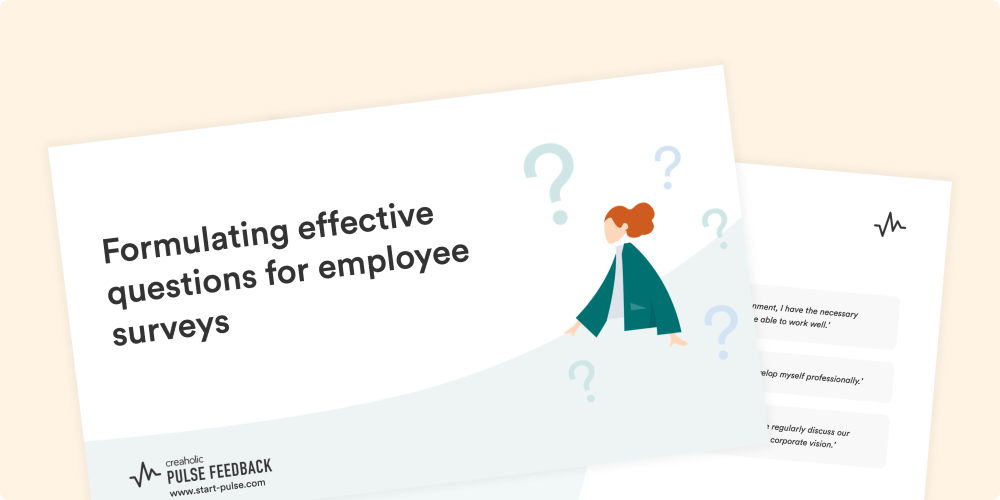
Free guide to effective questions
You'll find more examples and the most common pitfalls in wording questions in our guide to effective questions.
Download the guideFrom questions to impact with specialised software
Good questions get you halfway there. What makes the difference is what happens after people submit their answers. General survey tools such as Google Forms or SurveyMonkey collect responses, but leave you on your own when it comes to analysing them and taking action.
Specialised employee survey software supports you at exactly these points:
- Real-time results, available as soon as answers are submitted
- AI insights that analyse comments automatically and bring out the key themes
- Simple analysis instead of manual work in spreadsheets, with comparisons over time and between teams
- Guided results discussions, so that teams turn the results into concrete actions
- GDPR-compliant hosting on AWS servers in the EU (Frankfurt and Dublin)
The software also saves you work while you prepare and run the survey:
- A catalogue of more than 120 research-based questions, plus your own questions with AI support
- Structured comment fields that steer feedback in a constructive direction
- Automatic invitations and reminders for high participation
- Simple surveys in several languages
You'll find a detailed comparison of the different options in our overview of employee survey providers. Our page on employee survey software shows how this works in Pulse Feedback.
Pulse Feedback: From questions to impact
Good questions are the start. Pulse Feedback turns them into impact with real-time results, AI analysis of comments and guided results discussions. Research-based and GDPR-compliant, with hosting in the EU.
Explore Pulse FeedbackFrequently asked questions
What questions should you ask in an employee survey?
Good employee surveys combine a small number of focused questions on topics such as engagement, leadership, collaboration and company culture. Each question combines a rating with a comment. Choose the topics that fit your goal, and one or two questions per topic.
How many questions should an employee survey have?
It depends on the format. For short pulse and team surveys, 4 to 7 questions are ideal, while comprehensive annual surveys can include 10 to 15 questions. A clear thematic focus matters more than broad coverage.
What should an employee survey questionnaire include?
A good employee survey questionnaire consists of a few focused questions per topic, a consistent rating scale and open comment fields. The most important questions come first, the questionnaire is kept deliberately short, and every question serves a specific goal. You'll find ready-made questionnaires to copy in the templates above.
What are good open-ended questions for an employee survey?
Good open-ended questions direct attention to specifics. A proven approach is to add two fields to every rating: one for what is going well and one for what employees would like to see. That way you learn the reason behind each rating and what could be improved in concrete terms.
Is there a free employee survey template?
Yes. You can use five free employee survey templates on engagement, collaboration, psychological safety, leadership and transformation. Each template needs only 4 to 5 questions, and you'll find all five in the templates section above.
How do you write good employee survey questions?
Cover only one aspect per question, phrase it neutrally rather than as a leading question, keep the language simple and short, link every question to a goal and test the questions with a few employees beforehand.
Which rating scale should you use in an employee survey?
Common choices are scales from 1 to 5 or 1 to 10, as well as agreement scales that range from complete disagreement to full agreement. The exact scale matters less than the comment behind it, because the comment explains the rating. The important thing is to keep the same scale over time, so that results stay comparable.
Are these employee survey questions based on research?
Yes. Our question bank was developed together with the Lucerne University of Applied Sciences and Arts, based on a literature review and the job demands-resources (JD-R) model from work psychology (Bakker & Demerouti). All questions were also tested for comprehensibility. Find out more in our article on the scientific basis of the question bank.
Do employee survey answers have to be anonymous?
No. Anonymity can make sense for very sensitive topics, but it often signals that open feedback is risky. Open responses encourage more constructive feedback and genuine dialogue. Which approach fits depends on the culture of trust in your organisation. Find out more in our article on the types of employee surveys.
References
1 Demerouti, E., Bakker, A. B., Nachreiner, F., & Schaufeli, W. B. (2001). The job demands-resources model of burnout. Journal of Applied Psychology, 86(3), 499–512. https://doi.org/10.1037/0021-9010.86.3.499
2 Bakker, A. B., & Demerouti, E. (2007). The Job Demands-Resources model: state of the art. Journal of Managerial Psychology, 22(3), 309–328. https://doi.org/10.1108/02683940710733115